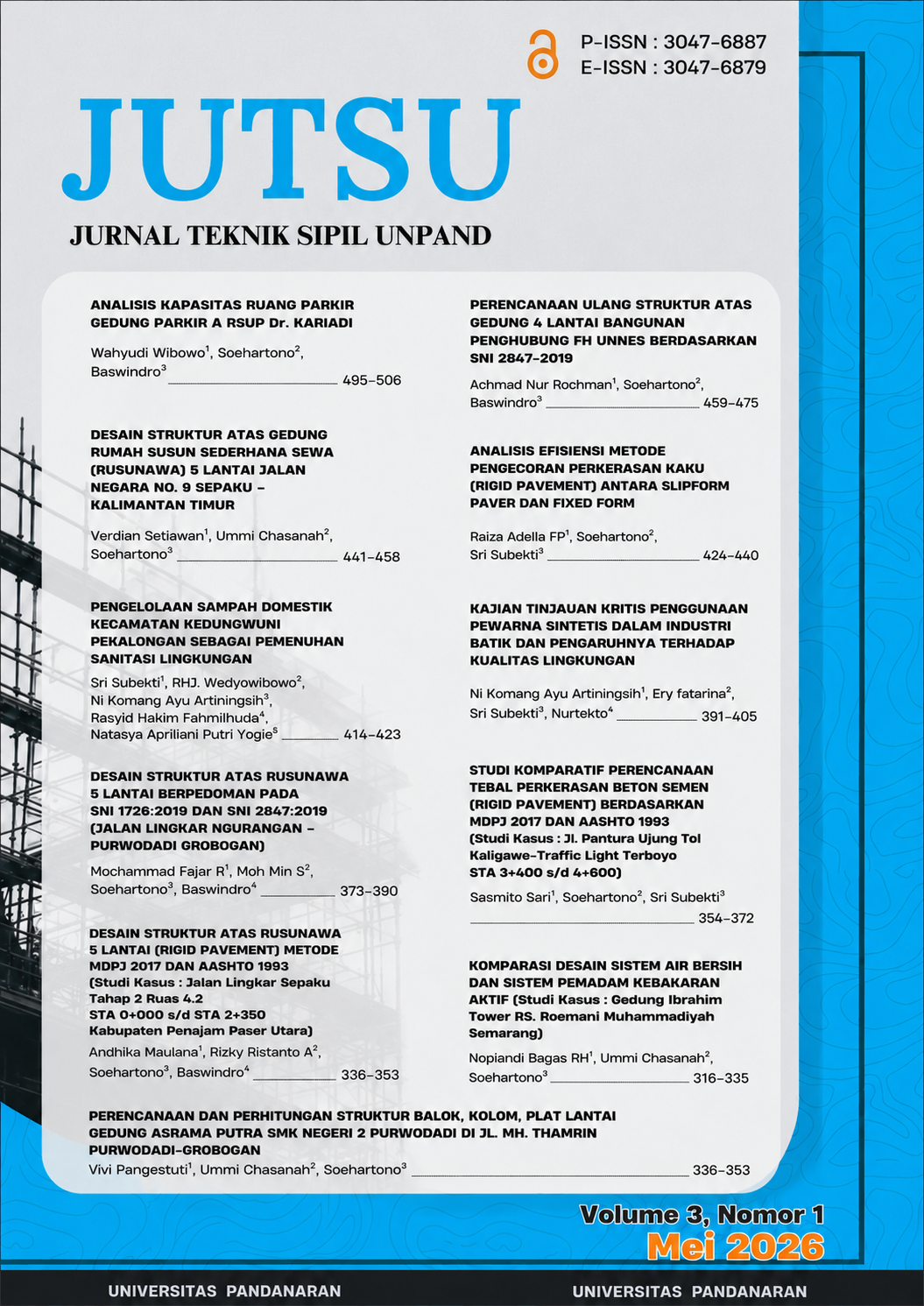
STUDI KOMPARATIF PERENCANAAN TEBAL PERKERASAN BETON SEMEN (RIGID PAVEMENT) BERDASARKAN MDPJ 2017 DAN AASHTO 1993 (Studi Kasus : Jl. Pantura Ujung Tol Kaligawe-Traffic Light Terboyo STA 3+400 s/d 4+600))
DOI:
https://doi.org/10.69796/6sn7gn25Keywords:
Rigid Pavement, MDPJ 2017, AASHTO 1993Abstract
The Kaligawe–Terboyo section of the Pantura (North Coast) road serves as a strategic logistics route characterized by high heavy-vehicle traffic volumes and environmental challenges, specifically tidal flooding and land subsidence. These conditions necessitate a rigid pavement design that is both structurally optimal and economically efficient. This study aims to compare concrete slab pavement thicknesses determined by two standard methods: the mechanistic-empirical *Manual Desain Perkerasan Jalan* (MDPJ) 2017 and the empirical AASHTO 1993. Primary and secondary data—including Average Daily Traffic (ADT), subgrade California Bearing Ratio (CBR) values, and traffic growth rates—were analyzed to derive design parameters. The calculations indicate that the MDPJ 2017 method yields a concrete slab thickness of 31 cm, whereas the AASHTO 1993 method results in a thickness of 35 cm. This 4 cm difference stems from differing philosophies regarding the determination of load factors and reliability parameters. From a technical standpoint, MDPJ 2017 offers a more efficient design for Indonesian national roads, as it accounts for actual load spectra. The study recommends adopting the MDPJ 2017 method to optimize construction costs while maintaining structural safety for road sections subjected to heavy traffic loads.
Downloads
Published
Issue
Section
License
Copyright (c) 2026 Sasmito Sari, Soehartono, Sri Subekti (Author)

This work is licensed under a Creative Commons Attribution 4.0 International License.


