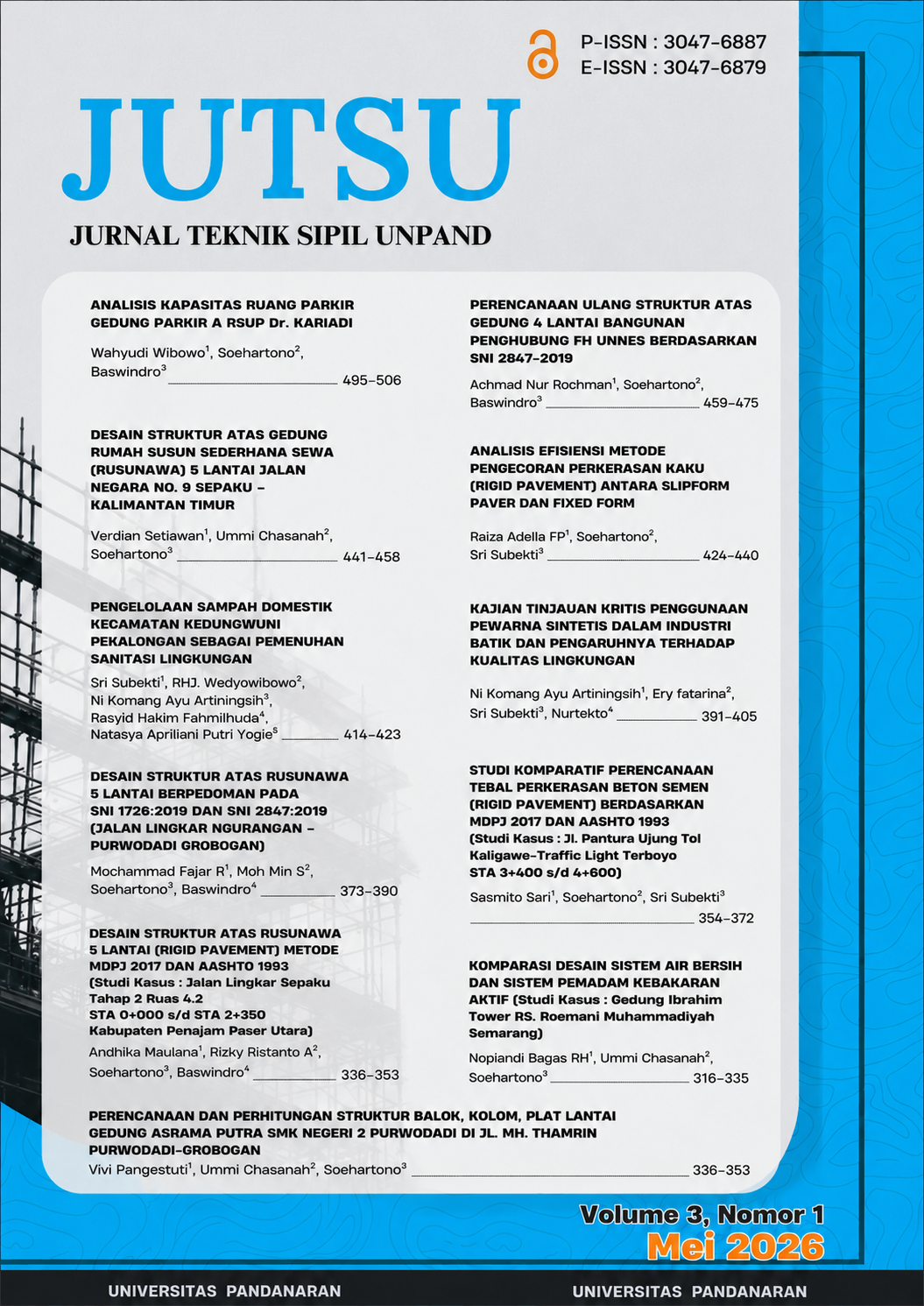
ANALISIS PERBANDINGAN TEBAL PERKERASAN KAKU (RIGID PAVEMENT) METODE MDPJ 2017 DAN AASHTO 1993 (Studi Kasus : Jalan Lingkar Sepaku Tahap 2 Ruas 4.2 STA 0+000 s.d STA 2+350 Kabupaten Penajam Paser Utara)
DOI:
https://doi.org/10.69796/mv1na856Keywords:
Rigid Pavement, MDPJ 2017, AASHTO 1993Abstract
Rigid pavement is a type of road pavement that utilizes cement concrete slabs as the primary layer to distribute traffic loads to the subgrade. Selecting the appropriate concrete slab thickness significantly influences the design life, structural performance, and cost-efficiency of road construction. This study aims to analyze and compare rigid pavement thickness based on two design methods the 2017 MDPJ (Road Pavement Design Manual) method and the 1993 AASHTO method using a case study of the Sepaku Ring Road Phase 2 – Section 4.2 (STA 0+000 to STA 2+350) in North Penajam Paser Regency, East Kalimantan. The data utilized includes Average Daily Traffic (ADT), subgrade condition data (CBR), and pavement material parameters. The analysis results indicate that the concrete slab thickness calculated using the 2017 MDPJ method is 25 cm, whereas the 1993 AASHTO method yields a thickness of 35 cm. This discrepancy in thickness arises from differences in design approaches, reliability factors, and drainage coefficient values employed by each method. The evaluation reveals that the 2017 MDPJ method produces a more economically efficient design without significantly compromising structural performance, while the 1993 AASHTO method provides a higher factor of safety regarding long-term traffic loads.
Downloads
Published
Issue
Section
License
Copyright (c) 2026 Andhika Maulana, Rizky Ristanto A, Soehartono, Baswindro (Author)

This work is licensed under a Creative Commons Attribution 4.0 International License.


